
For candidates, manual hunting becomes an unpaid second job: scrolling through stale aggregators, parsing timezone restrictions buried in fine print, retyping work history into clunky applicant tracking systems, and receiving silent rejections.
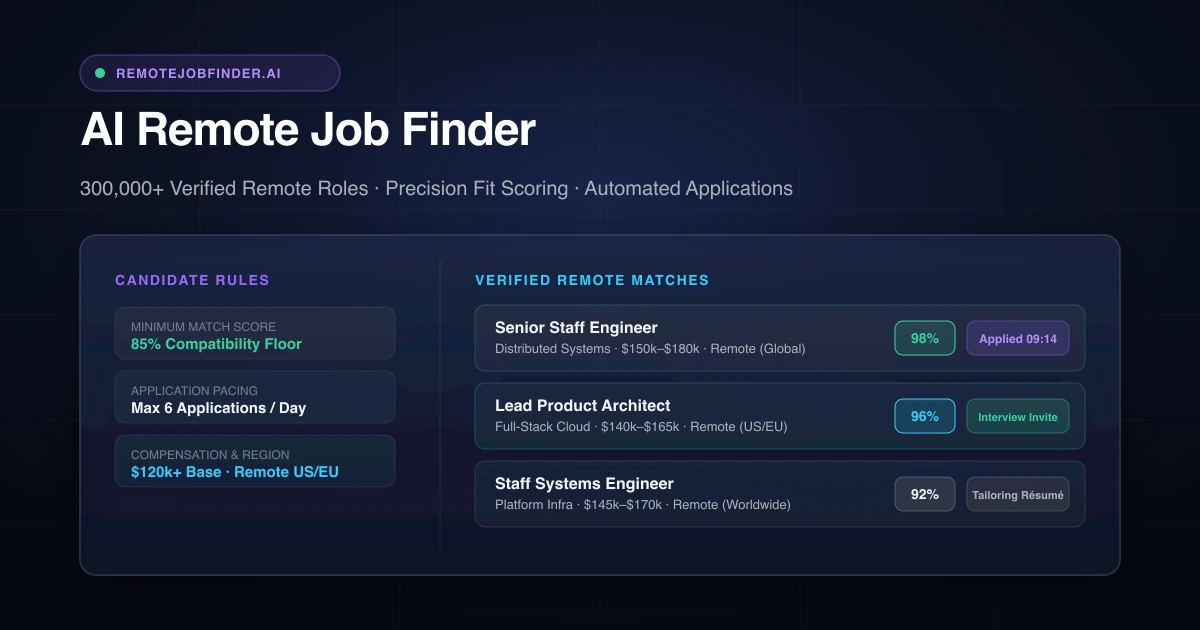
An AI remote job finder flips the process. Instead of spending twenty hours a week filling out forms, candidates use agents like RemoteJobFinder.ai to monitor verified employer career pages, score listings against their actual work history, and deliver tailored applications under strict personal rules.
Why the Traditional Remote Job Search Broke
Three systemic problems break the manual remote job search:
- Volume inflation: One-click applications flood hiring inboxes with thousands of unqualified submissions. Employers counter by tightening ATS keyword filters, rejecting strong candidates whose résumés omit specific phrasing.
- Ghost listings: Job aggregators optimize for click volume rather than accuracy. Stale postings remain live for months after hiring teams pause or fill the requisition.
- Hidden borders: Listings labeled "Remote" frequently hide strict payroll constraints—such as specific US state tax registrations or narrow timezone windows—revealed only on page four of the application form.
A dedicated remote job finder bypasses aggregators by indexing company career portals directly, standardizing geographic requirements, and comparing role requirements to a candidate's actual accomplishments.
How an AI Remote Job Finder Works
Rather than matching keywords blindly, modern search agents evaluate deep role requirements while leaving full control with the applicant.
Remote Job Finder structures the search into four stages:
1. Direct Career-Page Indexing
Third-party job boards copy and recycle listings. Remote Job Finder indexes over 300,000 remote positions directly from company career sites hosted on Ashby, Greenhouse, Lever, Workday, and BambooHR. Listings refresh daily and remove closed positions immediately, so you never apply to an expired role.
2. Semantic Fit Scoring
Standard job filters search for keywords. An AI remote job finder evaluates context:
- Scope and depth: Did you lead a cloud migration, build a design system, or manage distributed teams, and for how long?
- Domain relevance: Does your specific technology stack solve the problems described in the posting?
- Hard requirements: Does the job meet your minimum compensation, team size preferences, and timezone overlap?
On RemoteJobFinder.ai, every match carries a transparent percentage score alongside an explanation detailing why the role fits your background.
3. Fact-Preserving Résumé Tailoring
Generic résumés get ignored; fabricated résumés fail background checks. The middle ground is honest tailoring:
- Prioritizing relevant impact: For an infrastructure role, Kubernetes migrations and reliability improvements move to the top of your bullet points.
- Trimming irrelevant details: Tangential projects from five years ago shrink to save space.
- Focused cover letters: Short, 100-word notes written from your profile and the specific challenges outlined by the hiring team.
Every tailored document remains editable before submission, ensuring facts stay accurate.
4. Rule-Based Submissions
Automation without boundaries hurts your reputation. An effective remote job finder operates only inside limits you establish:
- Match threshold: Apply only to roles scoring 85% compatibility or higher.
- Daily caps: Limit submissions to 5–10 high-fit roles per day to keep follow-ups manageable.
- Exclusion lists: Skip specific recruiters, agencies, or former employers automatically.
- Manual review: Choose to approve every application before submission with one click.
Setting Up Your Search
To get consistent callbacks from an AI remote job finder, follow four rules:
- State your non-negotiables upfront: Set an explicit salary floor and define your working hours. If you need four hours of overlap with US Eastern Time, lock that constraint into your profile.
- Provide a detailed master résumé: Include real metrics, system scale, and shipped projects. The agent uses this master document as its factual baseline.
- Keep the match bar high: Set your floor at 85% or higher. Lower thresholds invite irrelevant recruiter screens; higher thresholds ensure high response rates.
- Check one unified inbox: Track interview requests and replies in one dashboard rather than chasing notifications across ten job boards.
From Application to Offer: Live Remote Interviews
Landing interviews is only half the battle. Remote interviews introduce unique challenges:
- Webcam eye contact: Video calls on Zoom, Google Meet, or Microsoft Teams make natural eye contact difficult when reviewing notes.
- Live problem solving: Engineering and product interviews demand fast technical recall and clear structural communication under pressure.
- Fast follow-ups: Interviewers press into behavioral specifics and cross-functional communication.
While Remote Job Finder secures the initial interview, InterviewCopilot provides live in-call assistance.
Docked right beneath your webcam in a compact Glance View, InterviewCopilot captures live audio from Zoom, Meet, or Teams, detects interviewer questions automatically, and displays concise talking points in under a second.
InterviewCopilot uses operating-system content protection on macOS and Windows to guarantee the overlay remains invisible during screen sharing, allowing you to maintain direct eye contact and structure your answers with confidence.
Pairing an automated remote job finder with a real-time interview copilot turns an exhausting search into a focused, reliable hiring pipeline.
Frequently Asked Questions
What makes a remote job finder different from a job board?
A job board is a passive directory where companies buy ads and candidates apply manually. A remote job finder is an active agent: it monitors direct career pages, scores listings against your background, tailors your materials honestly, and applies on your behalf under rules you define.
Can companies tell an application was automated?
Not when applications are tailored honestly. Low-quality bots blast generic templates to thousands of unrelated jobs. Agents like Remote Job Finder submit concise, role-specific materials highlighting genuine experience that matches the job description.
Does résumé tailoring change my work history?
No. Honest tailoring reorganizes real accomplishments so relevant experience appears first. It never invents skills, alters dates, or fabricates job titles.
How many jobs does RemoteJobFinder index?
RemoteJobFinder.ai indexes more than 300,000 active remote and hybrid roles directly from employer career portals, refreshed and deduplicated daily.
What should I do when interview invitations arrive?
Review the specific job description, prepare your core project examples, and launch InterviewCopilot on your desktop so you have real-time question detection and invisible guidance ready when your video call starts.