
Why Build a Story Bank?
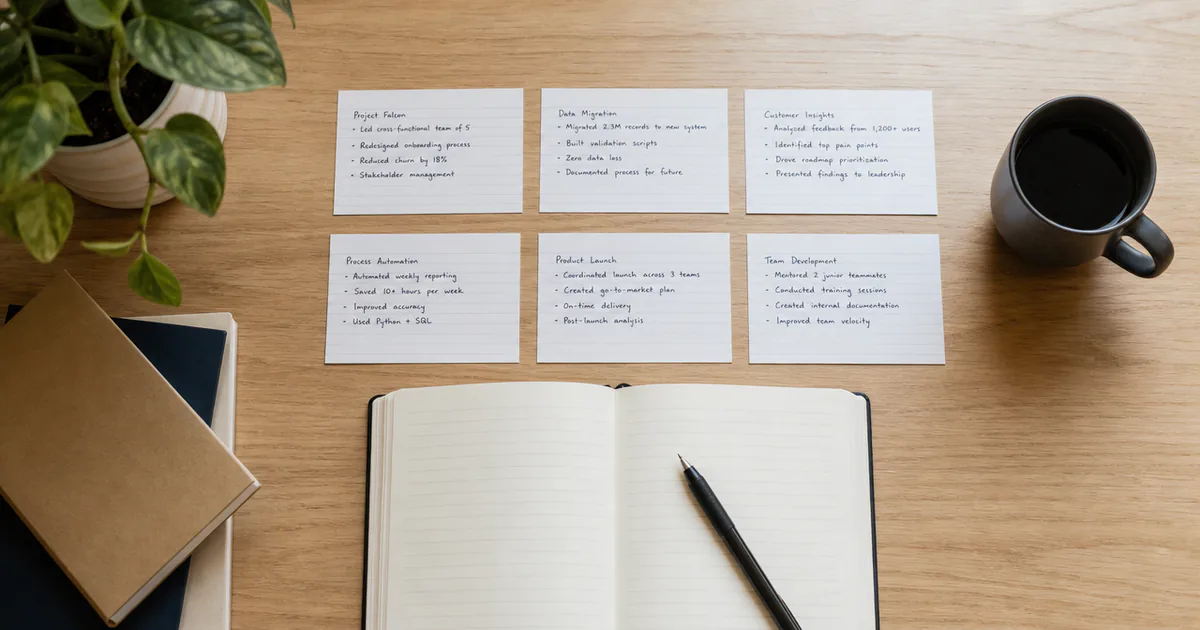
Memorizing dozens of rigid answers creates brittle preparation. If an interviewer alters a prompt, a memorized script falters. A single complex project yields multiple angles: an unexpected delay, a technical dispute, missing data, or an honest error.
Organizing your career history into an adaptable story bank lets one factual base address dozens of prompts. As the MIT CAPD STAR method guide suggests, effective answers rely on truthful examples, specific personal actions, and clear reflections. Keep background details brief so you can spend your time on what you decided, built, and learned.
Structure Answers with Five Layers
Candidates often bury their answers in backstory. When asked about a team dispute, they spend two minutes outlining company charts, product histories, and office politics. By the time they mention their own work, the listener has lost interest.
Use five concise layers to keep your response under two minutes:
- The Headline (10–15 seconds): Summarize the problem, your action, and the outcome in two sentences.
- Context and Constraints (10–20 seconds): State only the conditions that made the task hard, such as tight deadlines, limited budgets, or strict regulations.
- Actions and Trade-offs (40–55 seconds): Detail the options you weighed, the choice you made, and what you personally executed. Say "I" rather than "we" to define your role.
- Result and Reflection (15–20 seconds): Share measurable results and the lasting working habit you retained.
- The Check-In (5 seconds): Ask whether the interviewer wants technical detail or prefers to continue.
Keeping answers near two minutes preserves conversational pacing. For advice on pacing, see how long interview answers should be.
Six Essential Story Archetypes
Select six past initiatives across these common situations:
- The Urgent Bug: An unexpected outage or deadline that required immediate triage.
- The Disagreement: A debate over technical design or project scope settled with evidence. For interpersonal disputes, see our guide on conflict interview questions.
- The Ambiguous Task: A project with missing data or shifting scope where you documented assumptions and proceeded.
- The Honest Mistake: An error you caused, how you fixed it, and the safeguard you introduced. Read more on how to answer tell me about a time you failed.
- The Unpopular Trade-off: A choice that prioritized long-term reliability over a quick shortcut.
- The Fast Learning Curve: A project that forced you to master an unfamiliar tool or domain on short notice.
If your role does not tie directly to revenue, measure success through efficiency gains, lower error rates, fewer customer tickets, or reduced compliance risks. If you lack precise metrics, report what you observed plainly: "We did not log latency, but customer support escalations stopped after the release."
The Story Coverage Map
This fictional coverage map shows how to check your range of examples before an interview.
| Story Name | Archetype | Core Dilemma | Primary Competency | Involves Other Teams? |
|---|---|---|---|---|
| Payments Integration | Ambiguous Task | Partner API lacked key features; chose between delay and middleware. | Judgment, decision-making | Yes |
| Capstone Deadline | Urgent Bug | Teammate withdrew late, leaving database tasks unfinished. | Prioritization, delivery | No |
| Data Ingestion Script | Honest Mistake | Script overwrote records due to an unhandled edge case. | Accountability, recovery | Yes |
| Lab Workflow Alignment | Disagreement | Disputed sample handling methods before final testing. | Communication, reasoning | No |
| Contract Review Delay | Unpopular Trade-off | Paused vendor onboarding for a thorough security review. | Risk assessment, communication | Yes |
| Reporting Setup | Fast Learning Curve | Built client reports in an unfamiliar analytics tool in two weeks. | Adaptability, rapid ramp-up | Yes |
If your map lacks an example of error recovery or workplace disagreement, add one now rather than improvising under pressure.
Practice Examples
The following practice responses are fictional examples that illustrate structure, pacing, and trade-offs. Replace all project details with your own experience.
Example 1: Competing Priorities with Little Direction
During my senior capstone project, our client requested dynamic weather scrapers four weeks before delivery. Building custom scrapers threatened our deadline. I showed the sponsor that historical climate data captured the needed seasonal shifts without new code. They agreed, and we delivered on time. The department adopted our model for next semester's dining inventory planning.
Example 2: Disagreement on Project Direction
Our lead designer wanted to release a checkout redesign at once, but past releases had caused untraced drop-offs. I proposed routing 15 percent of traffic through the new flow using feature flags. That staged test revealed a mobile validation bug before full rollout. We fixed the issue and launched two weeks later with an overall 5 percent conversion gain.
Handling Follow-Up Probes
Interviewers ask follow-up questions to test whether you did the work yourself. Anticipate three common inquiries:
- Rejected Alternatives: "Why did you reject the simpler approach?" State why speed was not worth the risk: "The simpler script lacked transaction logs. Because we handled financial records, unlogged write errors outweighed the two days saved."
- Colleague Reservations: "Who pushed back on your proposal?" Explain how you resolved their doubts: "Our database administrator worried about cache-induced latency. We added query duration metrics so they could track backend performance directly."
- Retrospective Evaluation: "What would you do differently?" Point to an actionable adjustment: "I would loop the support team in earlier. Giving them three days before deployment left them rushing to write customer FAQs."
If an interviewer asks about a scenario you have never encountered, acknowledge the boundary directly and pivot to related experience: "I have not managed a production failover during a security breach. The closest situation was an unplanned payment gateway outage, where isolating services and tracking unprocessed records followed a similar process. I can walk through that if helpful."
Practice Routine and Story Card
Rehearse your answers out loud. Reading notes silently builds passive familiarity, but speaking develops recall. Drill your opening headlines until you can state the problem and outcome in 15 seconds without hesitation.
To build your bank, select one project from the past two years and complete this card:
- Project Name: (e.g., Inventory Sync Job)
- Archetype: (Urgent Bug / Disagreement / Ambiguous Task / Honest Mistake / Unpopular Trade-off / Fast Learning Curve)
- Headline (15 seconds): "When [problem arose], I [action taken], resulting in [measurable outcome]."
- Constraints: What limited your time, budget, or tools?
- Trade-off: What alternative did you reject, and why?
- Personal Actions: Three concrete things you evaluated, built, or coordinated.
- Outcome and Reflection: What durable improvement or habit remained?
- Likely Follow-up: What question will the interviewer ask next, and what is your factual response?
Complete this card for a few relevant projects to enter your interviews with clarity and adaptable evidence.