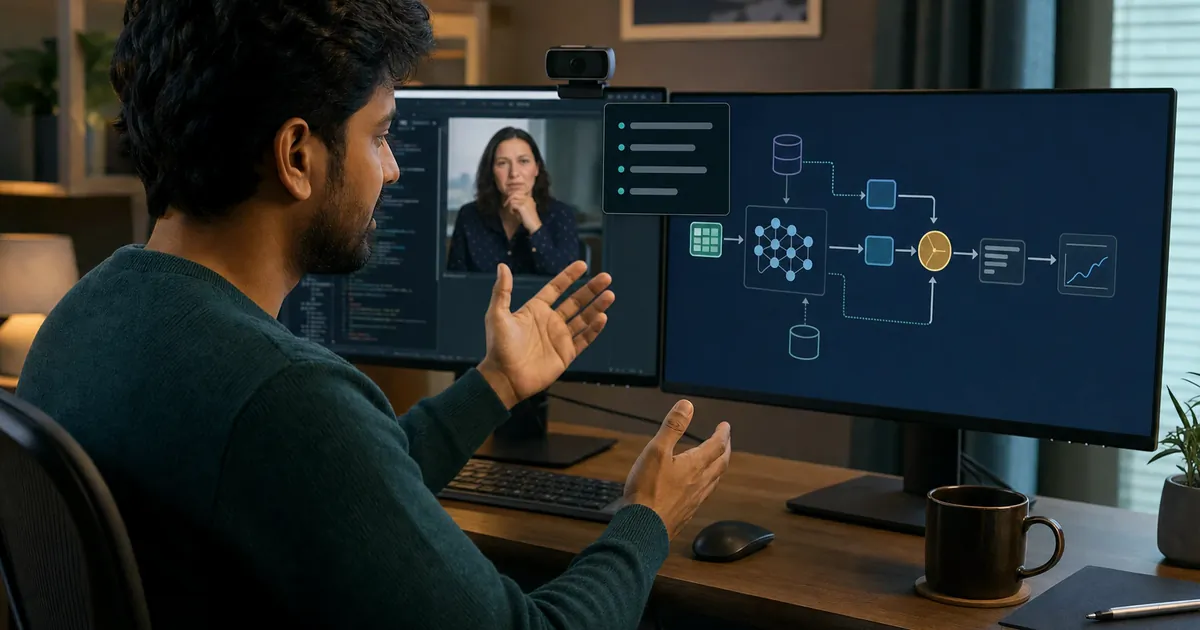

Modern software engineering interview loops require balancing three distinct disciplines: high-speed algorithmic problem solving, large-scale distributed system design, and behavioral engineering leadership. Even senior and staff engineers face cognitive overload when navigating live whiteboard architectures, complex runtime trade-offs, and behavioral storytelling in back-to-back rounds.
An AI interview assistant like Interview Copilot acts as your real-time engineering co-pilot. By capturing system audio from Zoom, Meet, and Teams and streaming tailored guidance into a native desktop overlay in under one second, InterviewCopilot helps you maintain clear structure, verify edge cases, and articulate technical trade-offs with calm authority.
The 3 Pillars of Software Engineering Interviews
InterviewCopilot adapts dynamically to the three primary evaluation stages in tech hiring:
1. Data Structures & Algorithms (Live Coding)
Technical panels score your algorithmic methodology more than quick memorization. During live coding rounds:
- Instant Pattern Recognition: When presented with array, graph, or string problems, the assistant quickly surfaces candidate patterns (e.g., sliding window, monotonic deque, topological sort, binary search over answer space).
- Edge-Case Checklists: Prompts you to address empty inputs, integer overflow, cycle traps, and duplicate elements before running test suites.
- Complexity Analysis: Instantly breaks down asymptotic Big-O time and auxiliary space constraints.
2. Large-Scale System Design
System design rounds assess your ability to design scalable, fault-tolerant distributed systems. InterviewCopilot surfaces a proven structural checklist:
- Requirements & SLOs: Clarifying read/write ratios, latency targets (p99 < 50ms), throughput (QPS), and data retention policies.
- High-Level Topology: Load balancers, API gateways, microservice boundaries, and caching layers (Redis, Memcached).
- Data Persistence: Relational (Postgres) vs NoSQL (Cassandra, DynamoDB) vs message streams (Kafka, RabbitMQ) based on ACID vs BASE requirements.
- Resilience Patterns: Circuit breakers, exponential backoff with jitter, idempotency keys, and rate limiting.
3. Engineering Leadership & Behavioral Rounds
Staff-plus and senior engineering roles demand demonstrated leadership. Grounded in your uploaded résumé, InterviewCopilot surfaces structured STAR examples:
- Production Incident Management: How you led a Sev-1 outage triage, conducted blameless post-mortems, and implemented preventive guardrails.
- Cross-Functional Alignment: Resolving technical friction between engineering, product, and security stakeholders.
- Technical Mentorship: Guiding junior engineers through complex codebase refactors and architectural RFCs.
Optimizing Your Engineering Profile Context
The guidance provided by InterviewCopilot is deeply personalized based on your background. To maximize signal during live calls, configure your candidate profile in advance:
- Tech Stack Specifics: Specify your primary languages (e.g., Go, Rust, TypeScript, Python) and frameworks so generated syntax is strictly idiomatic.
- Production Scale Numbers: Include real metrics from your career—e.g., "Scaled event ingestion to 150,000 requests/sec," "Reduced p99 database query latency by 42%," or "Migrated 30 microservices to Kubernetes."
- Role-Specific Keywords: Upload the target job description so the engine emphasizes the company's core challenges (e.g., event-driven architectures, financial ledger consistency, or distributed storage).
In-Call Execution: Spoken Prompts vs Visual Coding Tasks
Hands-Free Audio Capture
During conceptual discussions, InterviewCopilot continuously transcribes interviewer speech from your system audio. When the interviewer asks, "How does consensus work in Raft compared to Paxos?", guidance appears in your overlay in under a second without clicking a button or typing.
Hotkey Screenshot Analysis
When working in LeetCode, HackerRank, CoderPad, or an online IDE:
- Press the global screenshot shortcut.
- The copilot analyzes the problem statement, visible unit tests, and constraints.
- Review optimal algorithms, edge cases, and complexity benchmarks in Glance View.
Screen Sharing and Privacy on Technical Calls
Technical interviews frequently require sharing your screen to walk through code or draw diagrams.
InterviewCopilot features native operating-system content protection on macOS and Windows. The overlay window is completely excluded from Zoom, Meet, Teams, and browser screen captures. You can share your entire desktop or IDE with full confidence that the assistant remains 100% invisible to the interviewer.
Engineering Best Practices with Live AI
- Explain the "Why": Never recite code or architecture blindly. Use the copilot's structure to anchor your thoughts, then explain why an algorithmic choice or architectural partition makes sense.
- Narrate Your Thinking: Keep communication continuous. If evaluating two approaches (e.g., DFS vs BFS for shortest path in unweighted graphs), discuss the trade-offs aloud.
- Verify Assumptions: Treat AI suggestions as structural prompts. Confirm constraints with your interviewer before writing code.
For a deeper dive into architecture rounds, explore our system design interview assistant guide or learn how a dedicated copilot compares to standard chat tools in InterviewCopilot vs ChatGPT.
Frequently Asked Questions
Can InterviewCopilot assist with both coding and system design in the same session?
Yes. InterviewCopilot operates seamlessly across the entire interview session. It captures spoken system design discussions automatically and offers instant hotkey screenshot analysis for visual coding problems.
Does the app slow down my computer during resource-heavy IDE tasks?
No. InterviewCopilot is built as a lightweight native desktop binary that offloads transcription and inference to high-speed cloud infrastructure. It consumes minimal CPU and memory, leaving your IDE, Docker containers, and browser completely unhindered.
What languages and frameworks are supported?
InterviewCopilot supports all major programming languages, including Python, JavaScript/TypeScript, Go, Java, C++, Rust, C#, and SQL, along with standard cloud platforms (AWS, GCP, Azure) and distributed architectures.
Bottom Line
An AI interview assistant is the ultimate competitive advantage for software engineers. By combining hands-free audio transcription, sub-second streaming guidance, and complete screen-share invisibility, InterviewCopilot frees you from cognitive fatigue—allowing you to showcase your true technical problem-solving capabilities and land top-tier engineering offers.